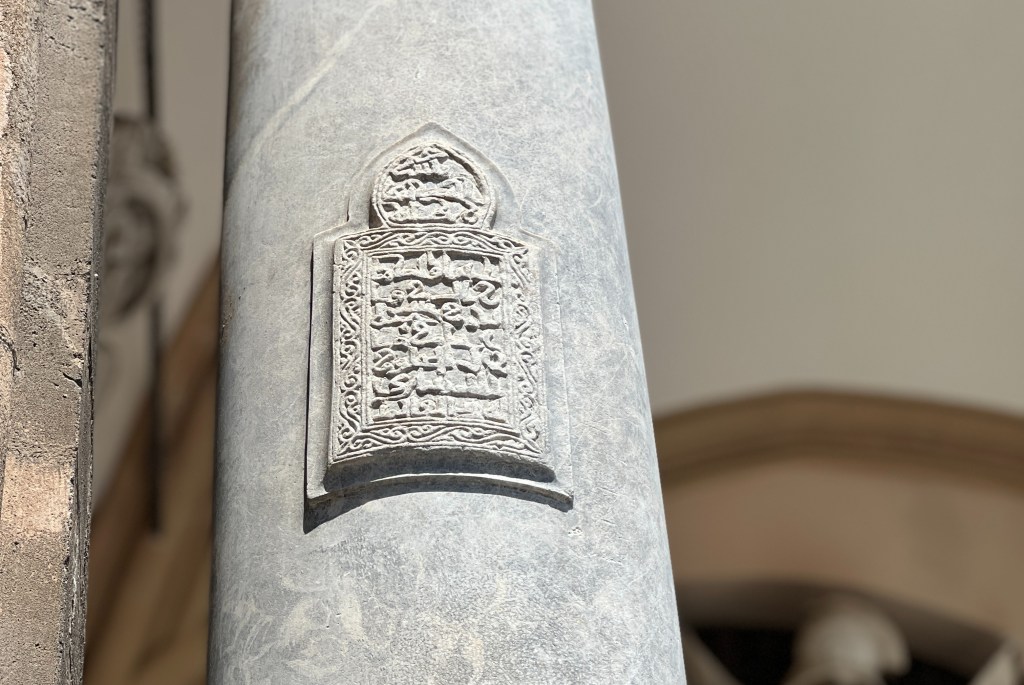
Near the top of the far left column at the entrance of the Cathedral of Palermo, “Assumption of the Virgin Mary,” sits an ornate qur’anic inscription. This column, which holds up the portico (the triangular roof structure) dates back much further than the 15th century portico or the 11th century cathedral.
The inscription is in Kufic, the oldest calligraphic form Arabic script. It contains an abbreviation of Surah 7 Al A’raf, verse 54 from the Qur’an. Surah means “chapter” and Al A’raf translates to “The Heights.” The full verse is translated below:
“Indeed your Lord is Allah Who created the heavens and the earth in six Days, then established Himself on the Throne. He makes the day and night overlap in rapid succession. He created the sun, the moon, and the stars—all subjected by His command. The creation and the command belong to Him ˹alone˺. Blessed is Allah—Lord of all worlds!”
A beautiful audio recording of Al A’raf 54 can be listened to here.
There is surprisingly little research and few sources that shed light on the story of this inscription. The Cathedral’s website affirmatively states that the inscribed column was previously part of the Grand Mosque of Palermo or “Masjid al-Jāmi`” of Bal’harm (the Arabic name for Palermo). The mosque had been a Byzantine cathedral prior to the Aghlabid takeover of Palermo in 831. Palermo, which displaced Siracusa as the Island’s capital, went on to become the seat of an emirate and later on of the most important cities of the Islamic world.1 It was almost completely a Muslim city with up to 300 mosques, equal to the Syrian capital of Aleppo.2 The Grand Mosque, which was said to have been capable of “containing 7,000 faithful,” was later “modified” once again to be a cathedral after the invasion of the Normans in 1072.3
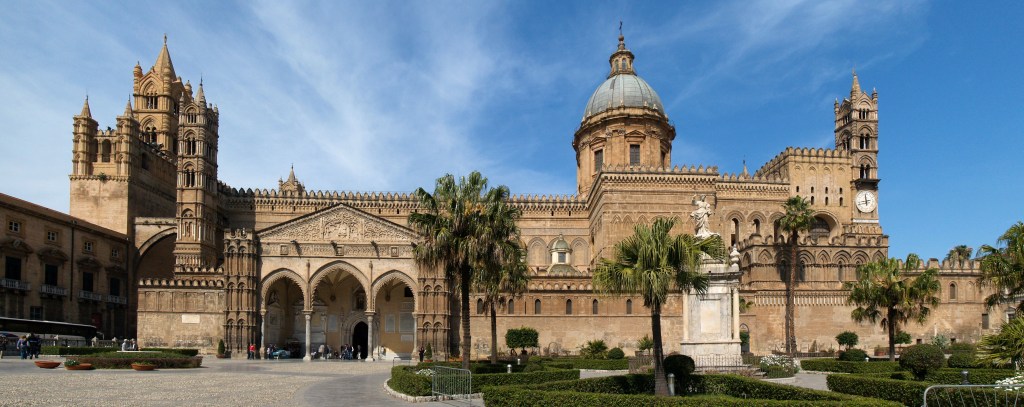
Multiple sources share the “recycled materials” theory. Essentially, the practice of recycling was normal at the time. Given that it was part of the pre-existing structure, a marble column, usually expensive, could be easily reused. Several sources agree that because the meaning of the inscription is such that one might find it in the Bible, it was inoffensive enough to be included on a Catholic cathedral. That the inclusion of the qur’anic inscription was an intentional homage to Sicily’s Muslim past or deliberate symbol of multiculturalism seems indisputable. After all, there are no other Catholic cathedrals in Europe with a qur’anic verse inscribed at their entrance.
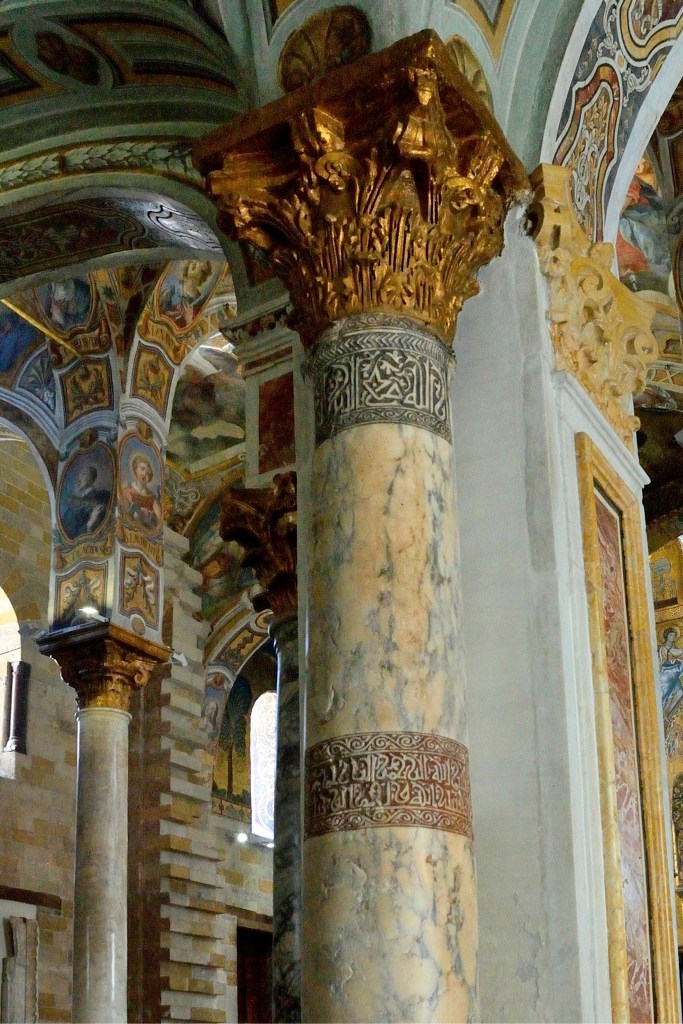
Two similar qur’anic inscriptions can be found on columns in Palermo’s nearby in Santa Maria dell’Ammiraglio. church, colloquially called “La Martorana.” The church, which was built in 1143 was similarly the location of a masjid, and many of the pillars were reused.3 The inscription pictured below contains the “Basmala” phrase, “In the name of God, the Merciful, the Compassionate. God is sufficient for me and He is the best advocate.”4
Many other columns containing qur’anic inscriptions exist across Sicily such as the ones in Palazzo Abatellis (Galleria Regionale) and the Magione Basilica in Palermo. There is a beautifully filmed video by RAI that shows three columns and dozens of similar items from the Agostino Pepoli Regional Museum and Library of Fardelliana in Trapani. Yet, none are placed so centrally and underscore so starkly the multilayered history of Sicily as the inscription on the cathedral of Palermo.
All in all, what is most striking about both Palermo’s Cathedral and la Martorana is the dynamic melting pot of cultures and styles they represent. Ruggero Longo captures this perfectly in his The First Norman Cathedral in Palermo. “As it stands today on the site of the original Late Antique cathedral, converted first into a mosque, and then back into a church, and then demolished and rebuilt as the church of the Most Holy Mother of God – arguably the first Norman cathedral on the island– then refashioned by Walter II in the late twelfth century and finally transformed by Ferdinando Fuga, is the transcultural building par excellence, the most eloquent witness to the overlapping of hidden layers and the stratification of cultures in Sicily.”5
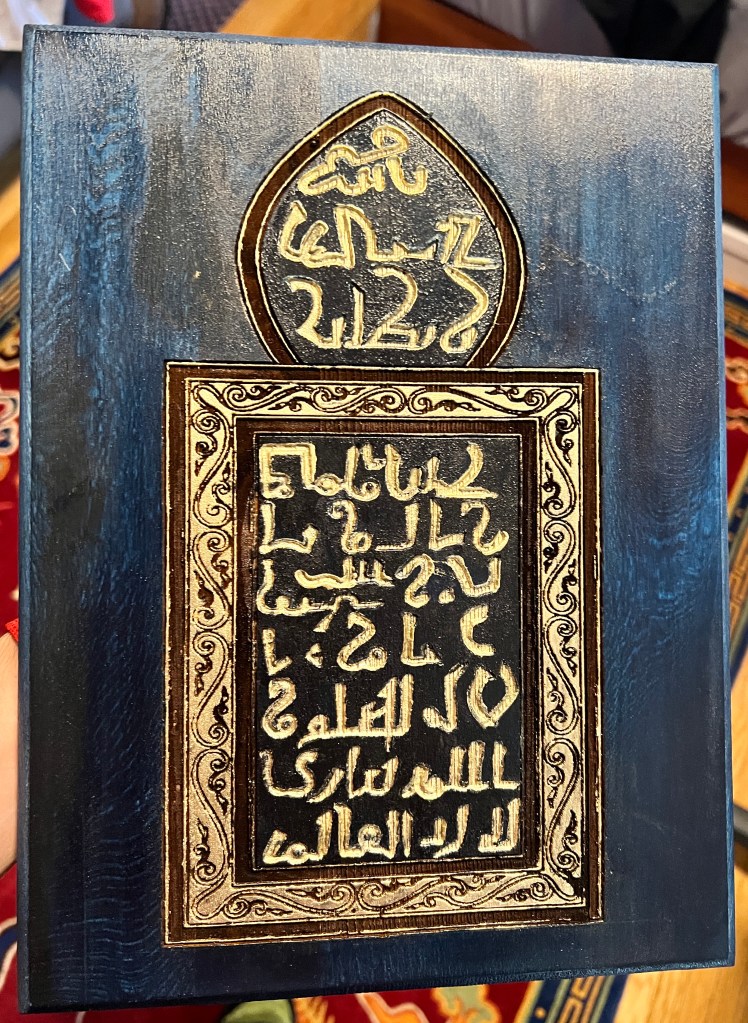
To end on a light note, I worked with The Arabesque to make an artistic recreation of the qur’anic inscription on on the Cathedral of Palermo. Tasneem and Ali, the incredibly kind and skilled artists, have more in stock as well as other items readers will recognize from Sicily.
Sources:
- Nef, Annliese, and Martin Thom. “Islamic Palermo and the Dār Al-Islām: Politics, Society and the Economy (from the Mid-9th to the Mid-11th Century).” A Companion to Medieval Palermo: The History of a Mediterranean City from 600 to 1500, vol. 5, Brill, Leiden, 2013, p. 41. Brill’s Companions to European History. ↩︎
- Granara, William, and ﺟﺮﺍﻧﺎﺭﺍﻭﻟﻴﻢ. “Ibn Hawqal in Sicily / ﺍﺑﻦ ﺣﻮﻗﻞ ﻓﻲ ﺻﻘﻠﻴﺔ.” Alif: Journal of Comparative Poetics, no. 3, 1983, pp. 94–99. JSTOR, https://doi.org/10.2307/521658. Accessed 22 Jan. 2024. p. 96. ↩︎
- Ibid. ↩︎
- Bourougaaoui, Soumaya. “L’arte Decorativa e Le Iscrizioni Arabe Nei Monumenti Arabo-Normanni in Sicilia.” Academia.edu, 30 Jan. 2018. ↩︎
- Johns, Jeremy. “The Arabic Inscriptions of the Norman Kings of Sicily: A Reinterpretation.” Academia.edu, 23 Apr. 2014. ↩︎
- Longo, Ruggero, and Jeremy Johns. “The First Norman Cathedral in Palermo. Robert Guiscard’s Church of the Most Holy Mother of God, Convivium.” Academia.edu, 1 Jan. 2018. ↩︎
Helpful further reading:
Palermo, Cara. “La Sura Del Corano Alla Cattedrale Di Palermo.” Cara Palermo, www.carapalermo.com, 14 Aug. 2023,.
Salerno, Vincenzo. “Palermo Cathedral .” The Best of Sicily Magazine, www.bestofsicily.com, 2012.
Schirò, Samuele. “L’iscrizione Araba Nella Cattedrale Di Palermo: Palermoviva.” L’iscrizione Araba Nella
Cattedrale Di Palermo, www.palermoviva.it , 16 Feb. 2022.
Skramstad, Per-Erik. “La Martorana (Santa Maria Dell’ammiraglio).” The Wonders of Sicily, The Wonders of Sicily.

 Siqilliya Mia